
Quick Answer: The best front porch garden ideas combine symmetrical entry planters (a matching pair flanking the front door), hanging baskets above railing height, seasonal pots along the porch floor, climbing vines on porch columns, and an evergreen-plus-seasonal-bloom mix that keeps the entryway styled year-round.
Has your front porch felt sad lately? Not bad, just blank. A doormat, maybe a wreath, and otherwise nothing growing, nothing styled, no reason for anyone walking past to look twice. A front-porch garden fixes that in a weekend.
The garden up front is also the part of the house that strangers actually see. The neighbor walking her dog, the delivery driver dropping a package, the friend pulling into the driveway for the first time all read the porch before they read anything else. A pair of urn planters by the door, a climbing rose up the column, and a window box under the front sill is enough to change the impression entirely.
Want every visitor to feel welcomed from the curb before they even ring the bell?
The Aesthetic Apartment Makeover Guide walks through every room with budget-friendly ideas. $17 now, soon $27.
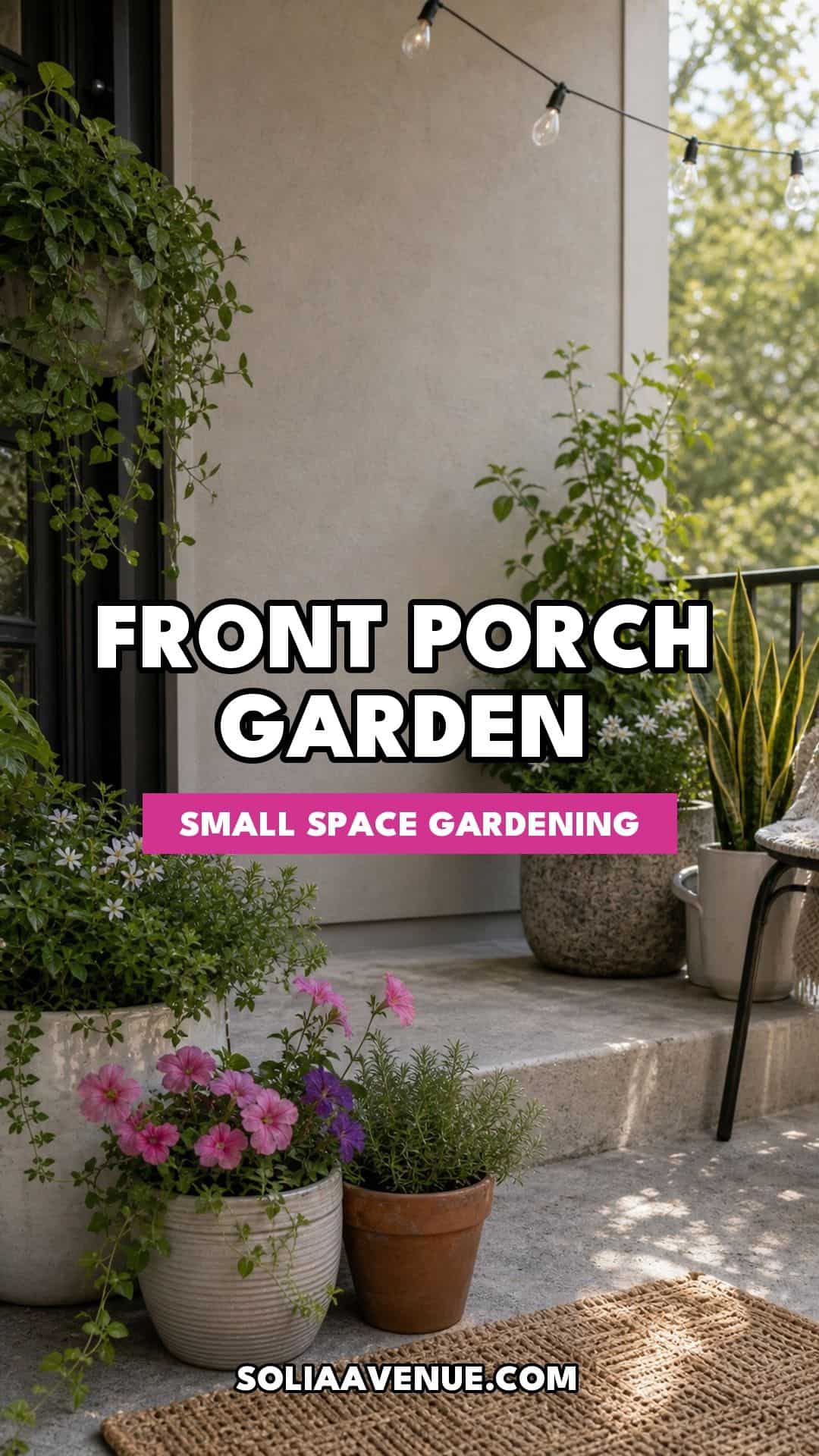
Recommended Front Porch Garden Essentials
The pieces that anchor a front porch garden, large statement planters, hanging baskets, window boxes, decorative pots, and outdoor lighting.


Recommended blogs to read:
- Summer front porch decorating ideas
- Small apartment patio ideas
- Boho outdoor patio ideas
- Spring yard decor ideas
- Fall patio decor ideas
Entry-Door Anchors
1. Use symmetrical planters for a balanced look
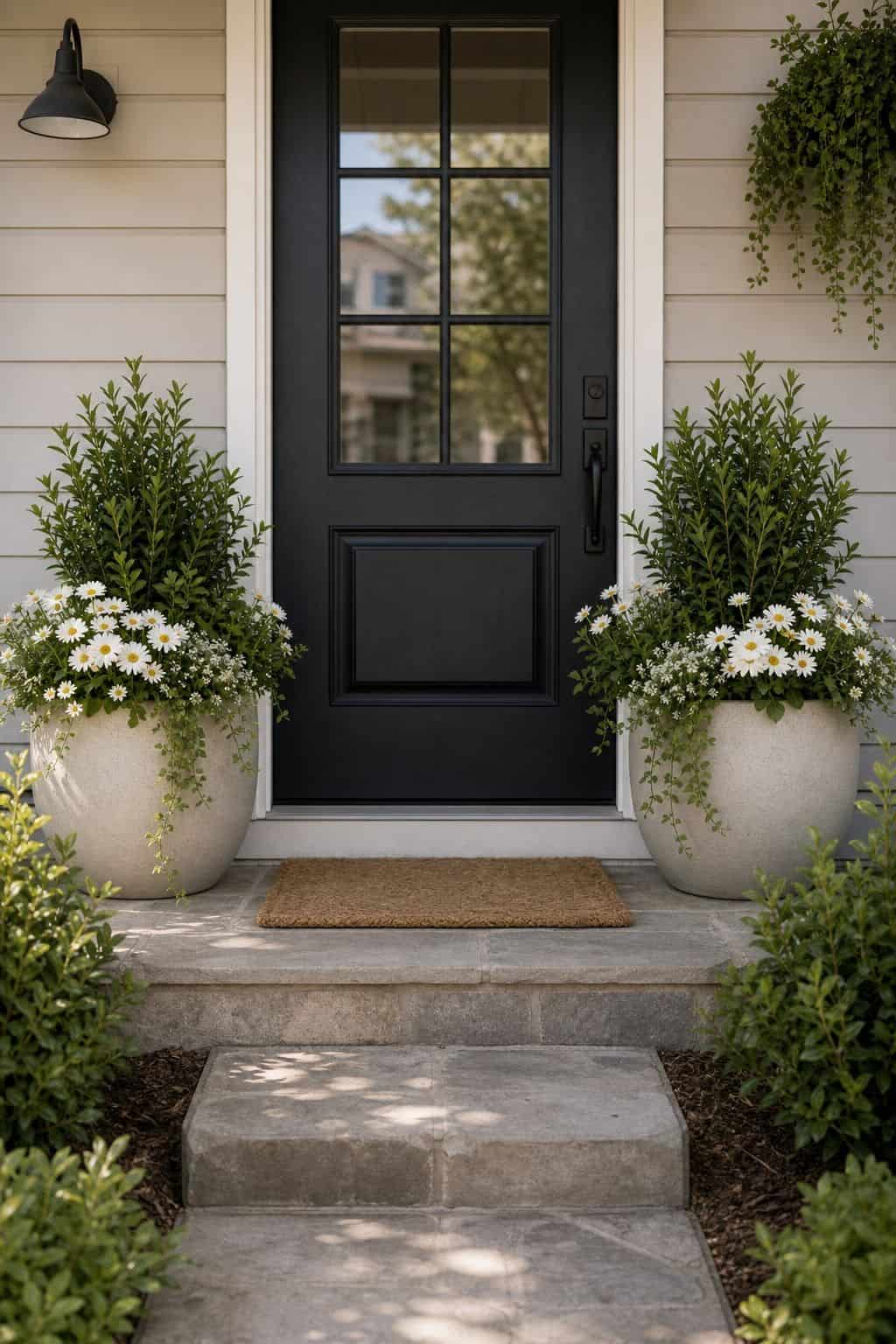


A matched pair of planters flanking the front door is the most-impact entry move in front porch gardening. The symmetry telegraphs intention, and the same planter on both sides reads more designed than a mixed collection of pots.
Pick large planters (16-24 inches in diameter, 18-30 inches tall) in matte terracotta, weathered concrete, glazed ceramic, or fiberglass. Plant identically, two boxwoods, two topiary spirals, two seasonal flowering combinations, two dwarf evergreens. The visual pair anchors the door as the focal point.
Go a size larger than feels right, since the most common porch mistake is planters that look like an afterthought next to a full-height door. Fiberglass is the practical choice if the pair ever needs to move, since a wet concrete planter this size is genuinely hard to lift. Setting each planter on a small caster tray or pot feet keeps water from pooling and staining the porch floor underneath.
Read more: Raised Garden Bed Ideas That Turn Any Outdoor Space Into Something
2. Place large statement pots with tall grasses or shrubs
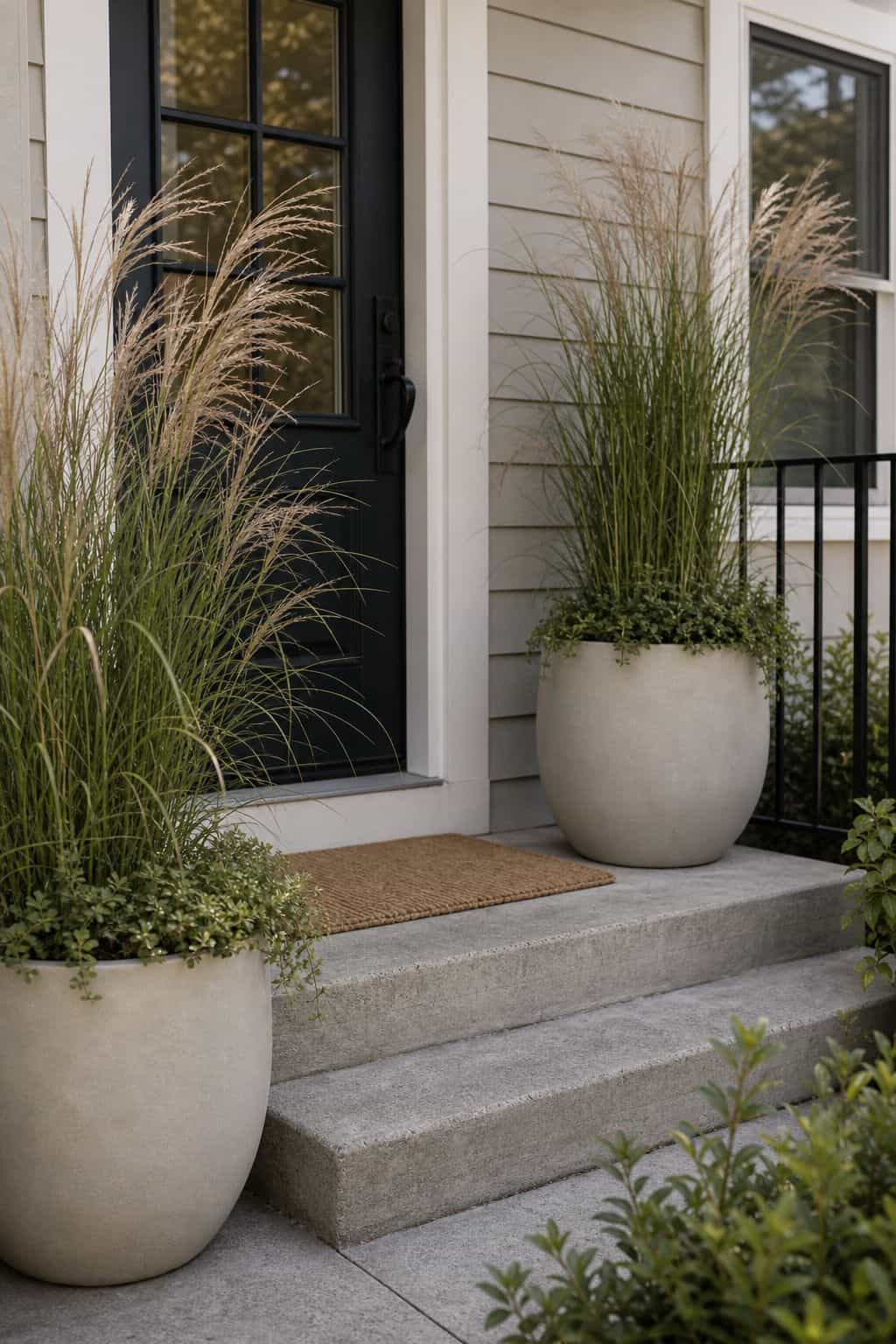

Beyond the matching pair flanking the door, one or two larger statement pots (24-30 inches diameter, 30-40 inches tall) placed at the porch entry or at the bottom of the steps add vertical drama. Ornamental grasses (purple fountain grass, blue oat grass, miscanthus) wave with breeze and hold visual interest through fall.
Compact shrubs (dwarf Japanese maple, small magnolia, boxwood spirals) bring permanent structure. Plant in containers large enough to handle root growth without daily watering, the larger the pot, the longer between waterings.
Ornamental grasses keep earning their spot well past summer, since the dried plumes hold shape and movement straight through fall and into winter. A statement pot reads best slightly off to one side rather than dead center, where it frames the entry instead of blocking it. With a perennial grass or shrub, the same pot greets visitors year after year with only an occasional trim.
Read more: Top 18 Garden Summer Decor Ideas to Transform Your Outdoor Space
3. Use colorful potted flowers to frame the entrance
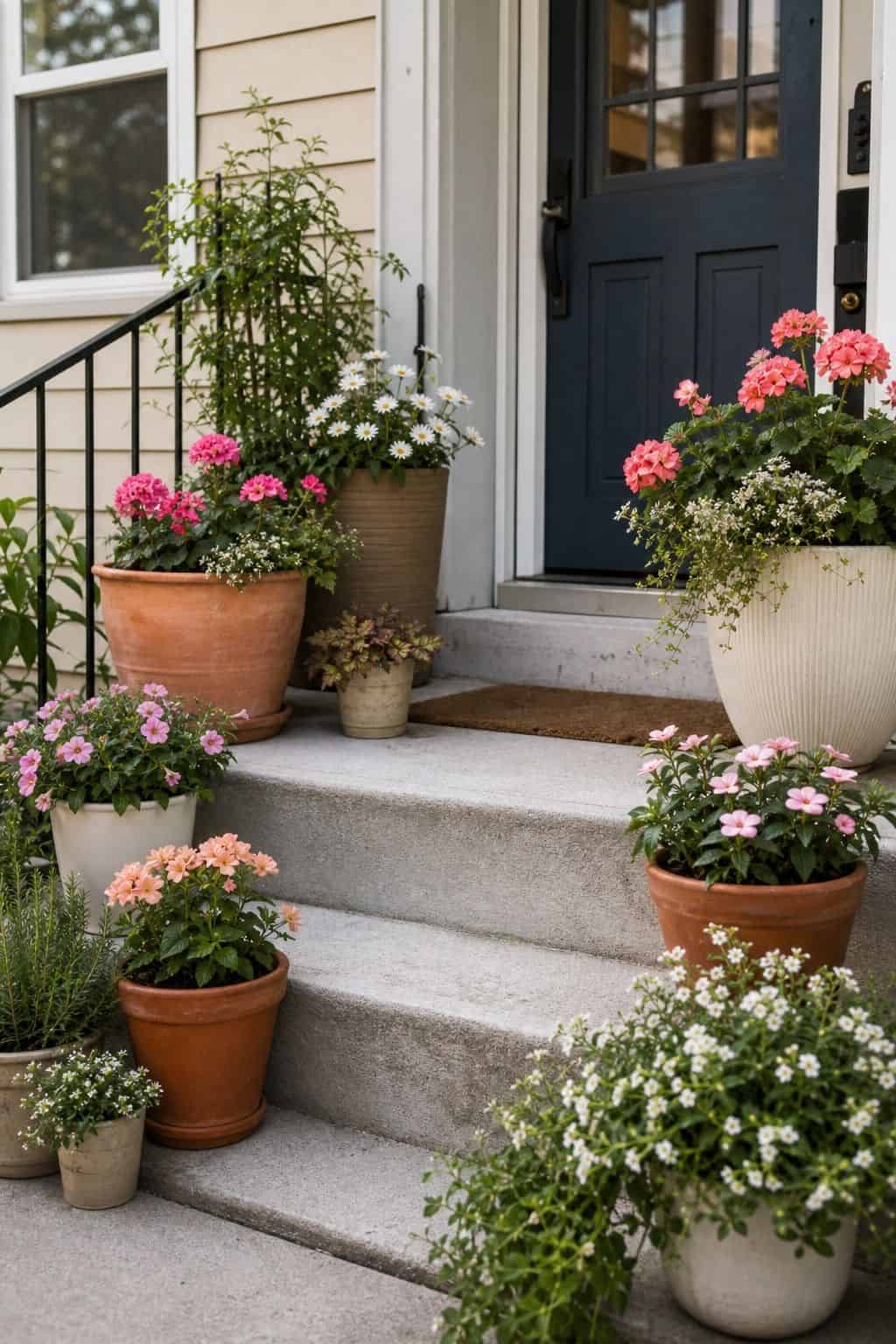


Three to five seasonal flowering pots in coordinated colors, scattered between the entry planters and the door, layer warmth into the entry. Match the bloom palette to the door color (red door pairs with pink and white flowers; navy door with yellow and white; black door with everything).
Spring lean into tulips, daffodils, pansies. Summer use geraniums, petunias, calibrachoa, lantana. Fall switch to mums, ornamental kale, pansies. Winter switch to evergreen sprigs in containers or holiday-specific plantings.
Sticking to two or three colors keeps a row of pots reading as a designed grouping rather than a mixed bag. Deadheading the spent blooms every few days keeps annuals flowering hard right through the season instead of fizzling early. Slipping plain nursery pots into prettier cachepots makes the seasonal swap a five-minute job, since you lift one pot out and drop the next one in.
4. Add a birdbath or feeder to attract wildlife
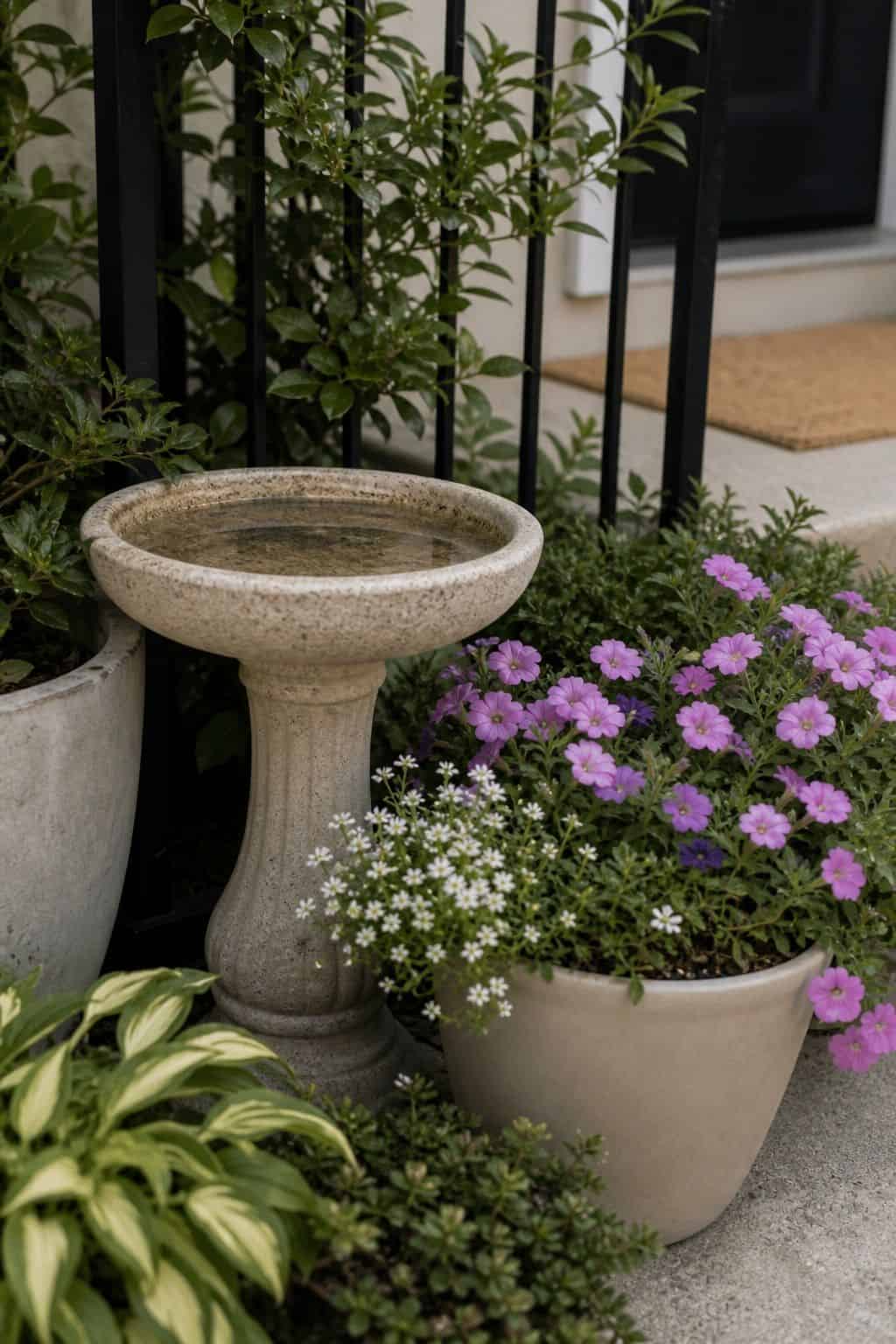


A birdbath or feeder lifts the porch garden from decorative to ecological. A 24-30 inch tall birdbath in cast stone, concrete, or copper-finished metal sits beside the entry steps as both a sculptural focal point and a working water source for birds.
Place 6-10 feet from the porch entry so birds feel safe approaching. Birdseed feeders attract more birds but also more squirrels and create more cleanup; suet feeders or hummingbird nectar feeders give the wildlife benefit with less mess.
A birdbath only stays in use if the water is fresh, so a quick rinse and refill every couple of days keeps the birds coming and the algae away. Set it near a shrub or planter rather than fully in the open, since birds like a nearby branch to retreat to. The gentle motion and soft sounds of visiting birds turn the porch into a small daily nature show you can watch from the front window.
Read more: Top 17 Sunroom Garden Ideas That Work With Minimal Effort
Vertical and Climbing Greens
5. Plant climbing vines around porch columns or railings
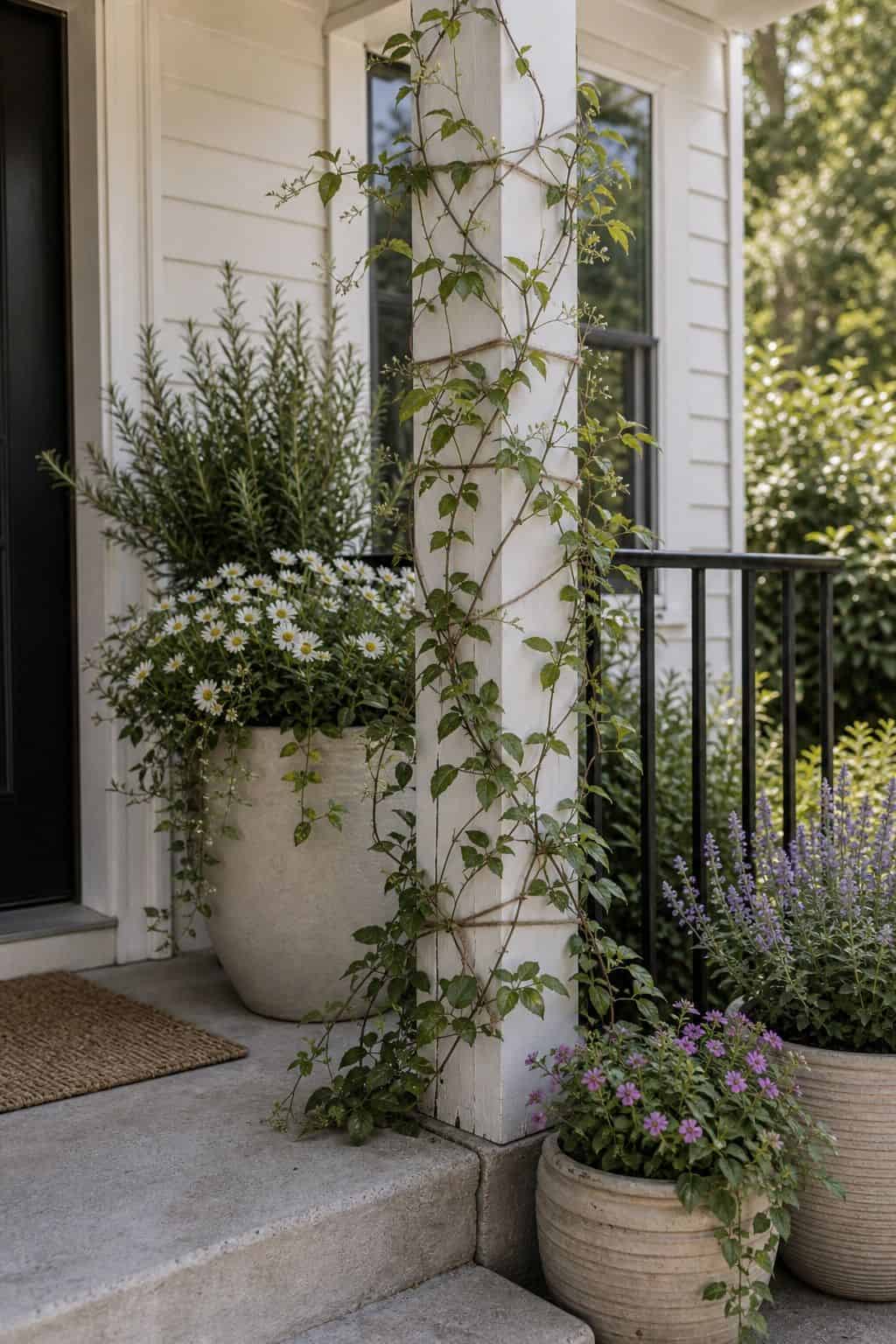


Climbing vines on porch columns or trellises turn vertical architecture into a living green feature. Mature clematis, climbing roses, jasmine, or wisteria all wrap columns with seasonal blooms.
For year-round green, Boston ivy, English ivy, or evergreen clematis stay leafed through winter. Train vines with garden ties or zip ties up the column, encouraging horizontal coverage. Most climbing vines take 2-3 years to fully establish; plant young and let them mature.
Fix a separate trellis or run a few wires just off the column rather than letting the vine cling straight to wood or paint, since aggressive vines can dig in and cause damage. A flowering climber like clematis or a climbing rose rewards the wait with seasonal blooms right at eye level by the door. The vine takes a couple of years, so plant it now and the porch keeps getting better with no further effort.
Read more: Top 17 Zen Garden Home Decor Ideas for a Calm, Serene Space
6. Add a small vertical garden or living wall
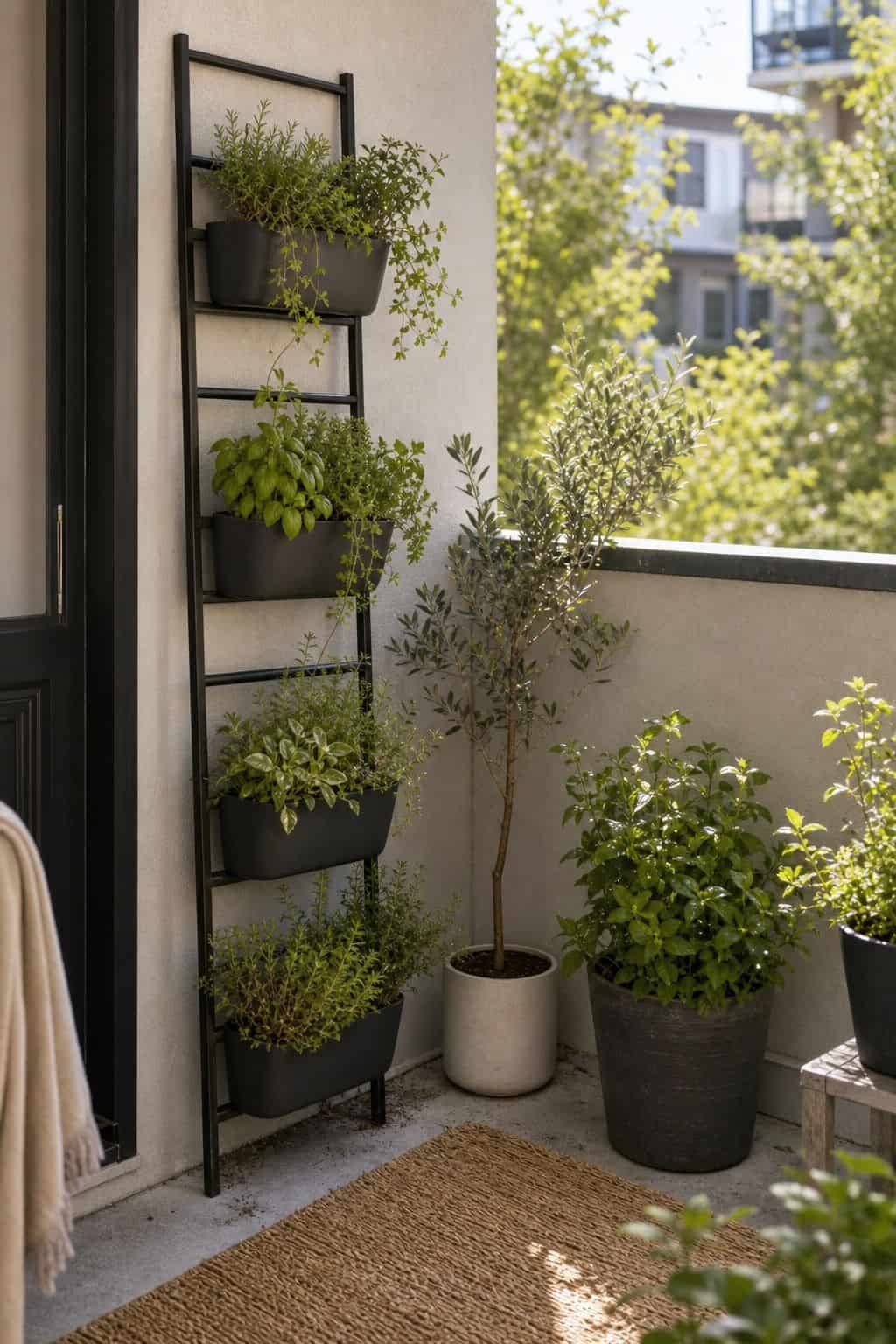


A small wall-mounted vertical garden on the porch wall or beside the door packs 20-30 plants into a single 3-4 foot frame. Modular grid systems (Algreen, Vertical Garden Solutions) attach to siding or stucco with corrosion-resistant brackets.
Plant with shade-tolerant ferns, ivy, small caladiums, or impatiens for a covered porch; sun-loving herbs, succulents, and trailing flowers for an exposed porch. Built-in drip irrigation reduces daily watering to a refill-once-a-week routine.
A living wall doubles as a screen, softening a view of the neighbor’s driveway or adding a bit of privacy to one end of the porch. Renters can get the look from a freestanding trellis-mounted version that needs no holes in the siding. Mount it on a wall that gets the light its plants want, since a vertical garden in deep shade slowly thins out no matter how it is watered.
Read more: Top 18 Front Porch Halloween Decor Ideas for Spooky Curb Appeal
7. Use window boxes filled with lively flowers
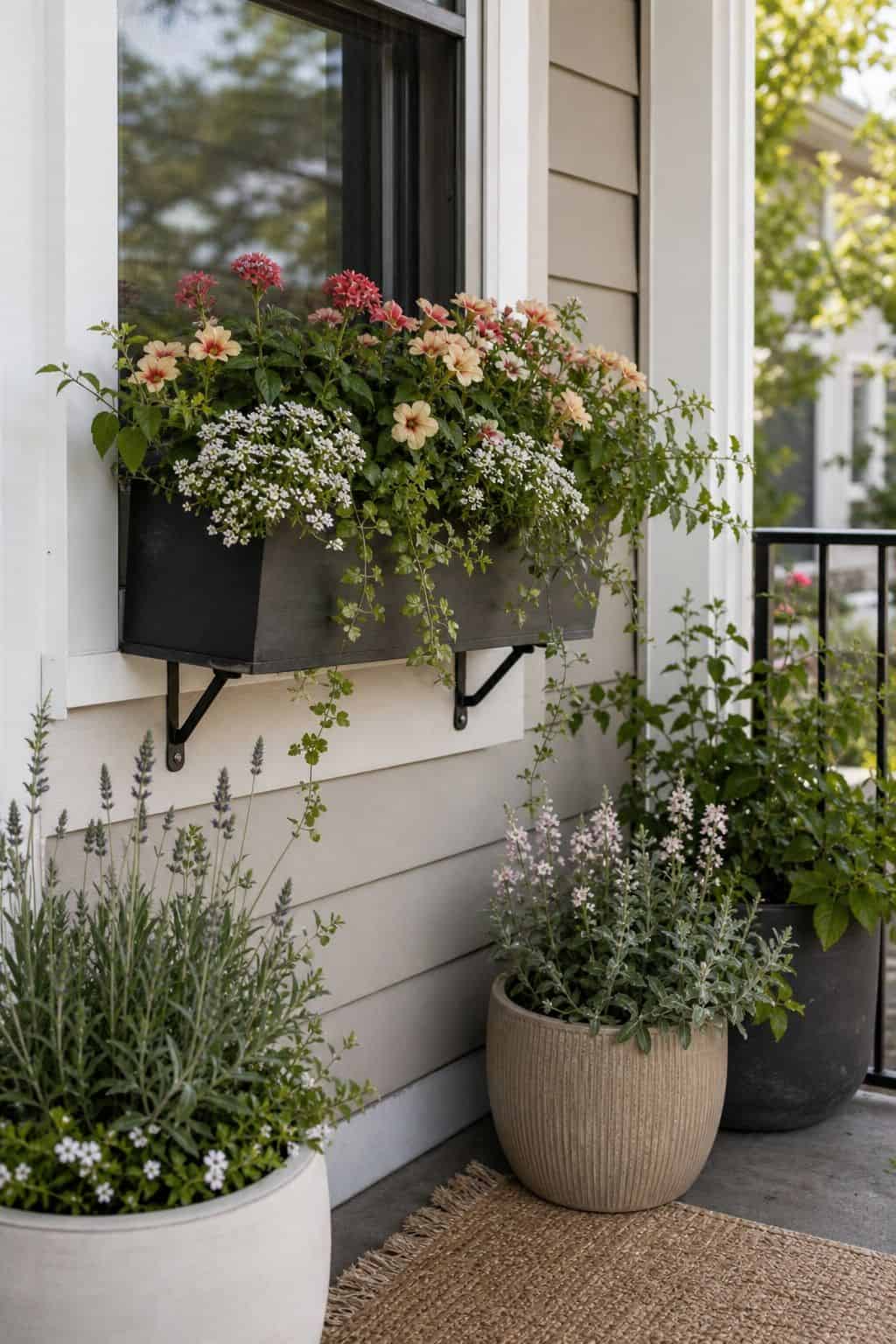


Window boxes mounted directly under porch windows or along the railing top extend the garden upward. Self-watering window boxes (Mayne, Achla, Greenes Fence) hold 1-2 gallons of soil per linear foot and water the plants for 5-7 days between refills.
Plant the classic thriller-filler-spiller formula, one tall plant in the back, mid-height fillers in the middle, trailing plants spilling over the front. Geraniums, lobelia, sweet potato vine, calibrachoa, and impatiens all work depending on sun exposure.
Bolt railing-mounted boxes securely with proper brackets rather than just resting them on the rail, since a soaked box catches wind and is heavier than it looks. Window boxes are one of the few upgrades that look as good from inside the house as from the street, framing the view through the glass. A self-watering box is worth the extra cost here, because a sun-baked box dries out fast on a hot afternoon.
Read more: Small Front Porch Ideas to Transform Your Entrance
8. Incorporate hanging baskets with trailing plants
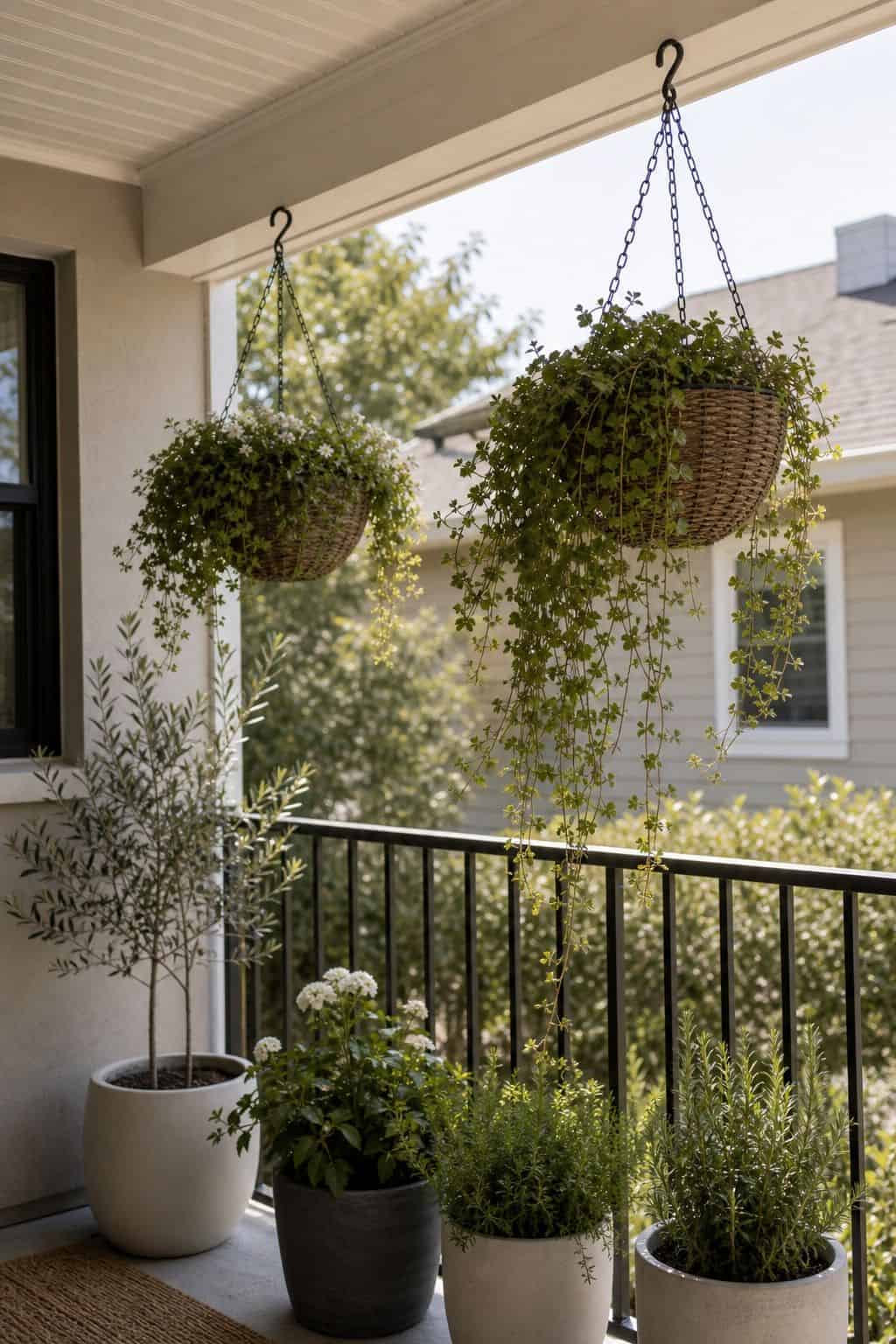


Hanging baskets from porch ceiling hooks or beam mounts add overhead greenery and free up floor space. Trailing flowers like petunia, calibrachoa, bacopa, ivy geranium, and trailing lobelia spill 2-3 feet for dramatic visual cascade.
Wire-frame baskets with coco liner hold the most soil and last several seasons; plastic baskets are lighter and easier to lift for watering. Hang at varied heights and pair with railing planters below for a layered cascade effect.
Hanging baskets dry fast since wind and sun reach them on every side, so a self-watering basket or a coco liner cuts the watering down to something manageable. Use a sturdy ceiling hook rated well above the soaked weight, and a swivel hook lets you turn the basket so the growth fills in evenly all the way around. A pulley-style hook is a small luxury that lowers the basket to a comfortable height for watering and lifts it back up.
Functional and Decorative Layers
9. Plant fragrant herbs in decorative containers
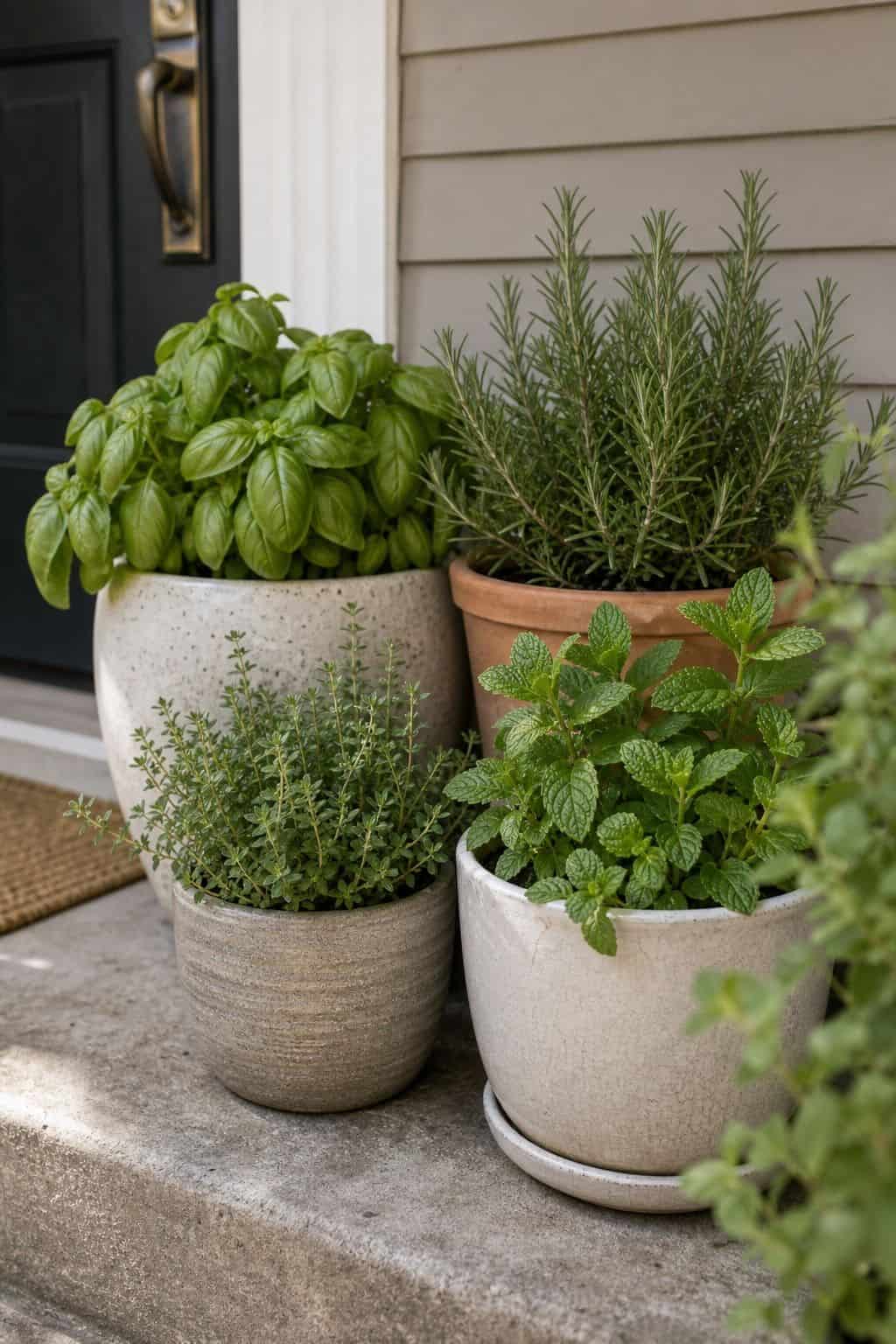


Herb containers near the front door give the porch a scent layer that nothing visual can deliver. Lavender, rosemary, mint, basil, and lemon balm all release fragrance when brushed against, making the porch entry an aromatic moment.
Plant in glazed ceramic, terracotta, or copper containers (10-14 inches across) and group three or four together at the corner of the porch or on a small side table. Herbs need 4-6 hours of sun minimum, so position accordingly.
Set the herb pots within arm’s reach of the door, so clipping a few sprigs on the way to the kitchen becomes effortless. Lavender and rosemary both double as quiet pest deterrents, since the scent that welcomes visitors also tends to keep mosquitoes at bay. Snipping the herbs often keeps them bushy and full, so regular use is also what keeps the pots looking their best.
Read more: Top 16 Avant-Garde Front Porch Spring Decor Ideas
10. Include a mix of evergreens and seasonal blooms
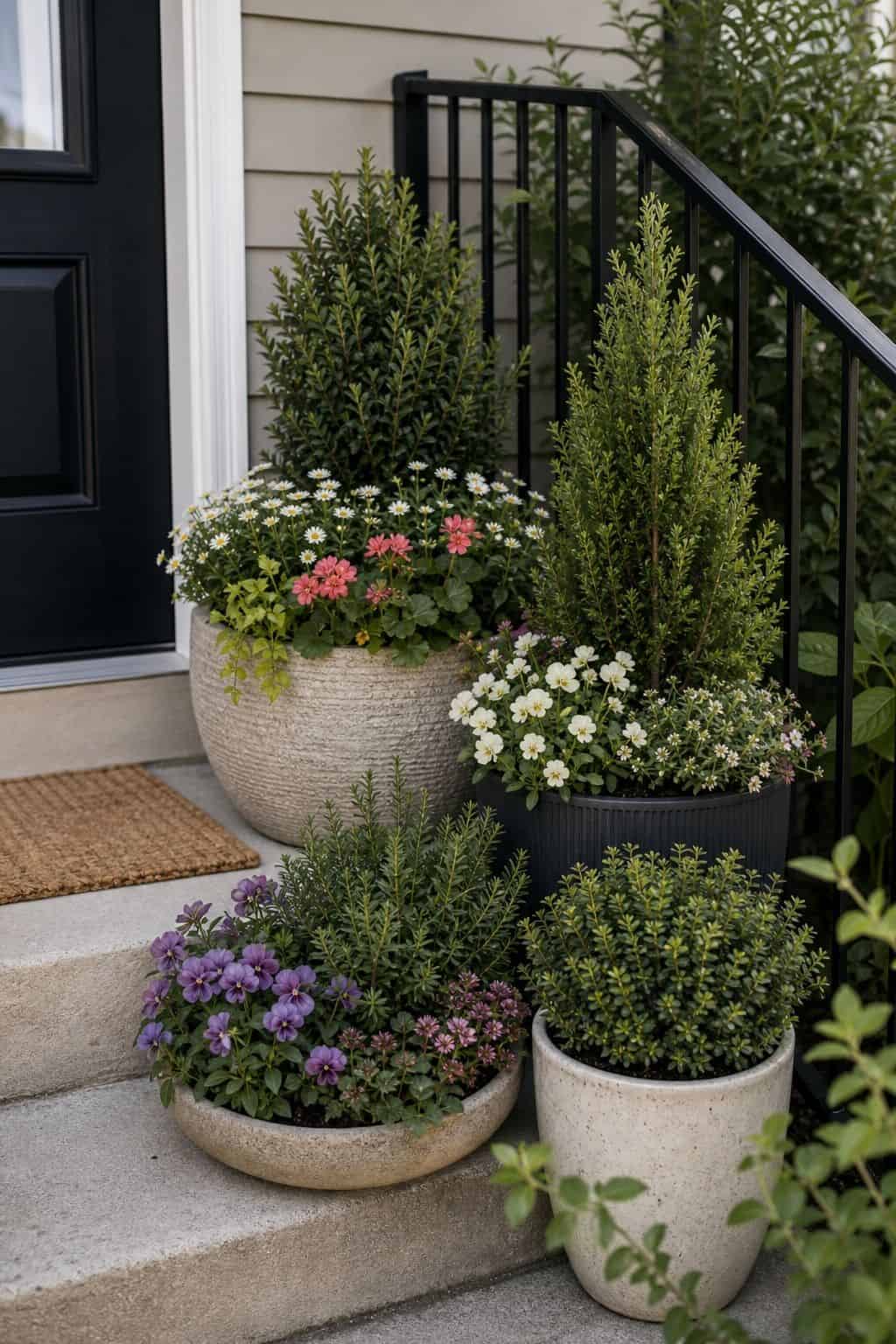


The smartest front porch gardens combine evergreen structure with seasonal flowering accents. Two or three permanent evergreens (boxwood, dwarf juniper, holly, small dwarf conifer) hold the porch styled through winter when flowers go dormant.
Add seasonal flowering plants in coordinating pots that rotate through the year. The result is a porch that always looks intentional, with the seasonal layer changing while the evergreen baseline stays.
The evergreens are what carry the porch through the dead weeks of winter, when bare pots would otherwise make the entry look abandoned. Treating the seasonal flowers as the easy-swap layer keeps each changeover quick, since you are refreshing a few pots rather than rebuilding the whole porch. A clipped boxwood or a small conifer also reads as care year-round, holding shape with almost no work.
Read more: Top 18 Front Porch Christmas Decor Ideas to Welcome the Season
11. Add solar-powered garden lights along the walkway
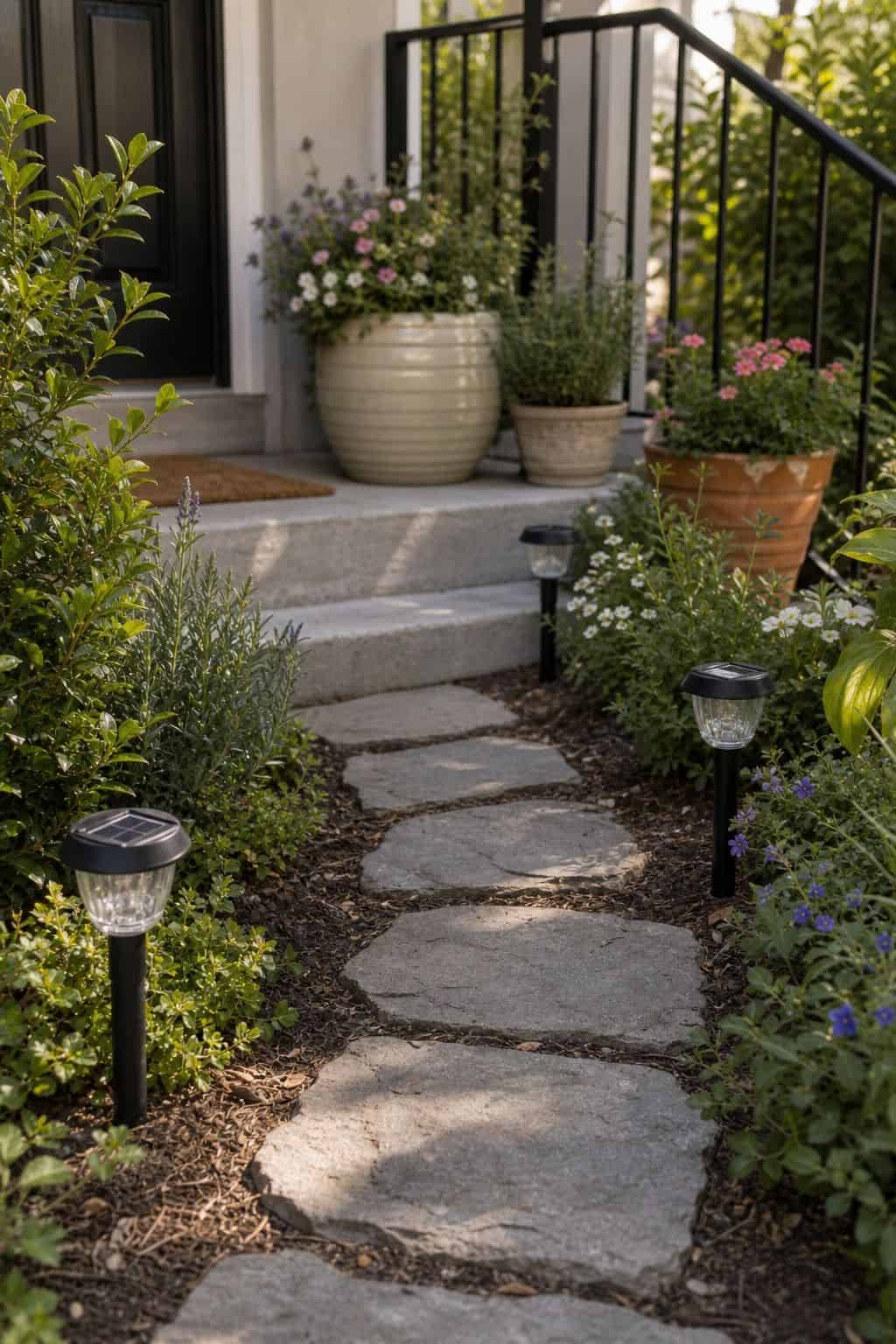


Solar path lights from the curb to the front door extend the porch garden’s visual presence into evening hours. Stake lights (12-18 inches tall) push into the ground at 4-6 foot intervals along the walkway, charging during the day and glowing at dusk.
Brushed metal and matte black finishes blend better with most front porch styles than the bright plastic versions. Pair with a porch lantern at the entry and 2-3 string lights overhead for the full evening welcome.
Push the stakes in where the small solar panels catch real daylight, since a panel shaded by a shrub gives only a dim, short glow. Beyond the welcome, lit path lights are a genuine safety touch, marking the steps and walkway edge for anyone arriving after dark. Warm-white bulbs feel inviting, while cool-white ones can read a little stark, so check the color temperature before buying.
Read more: Summer Door Hanger Ideas That Instantly Brighten Your Front Porch
12. Incorporate garden statues or decorative stakes
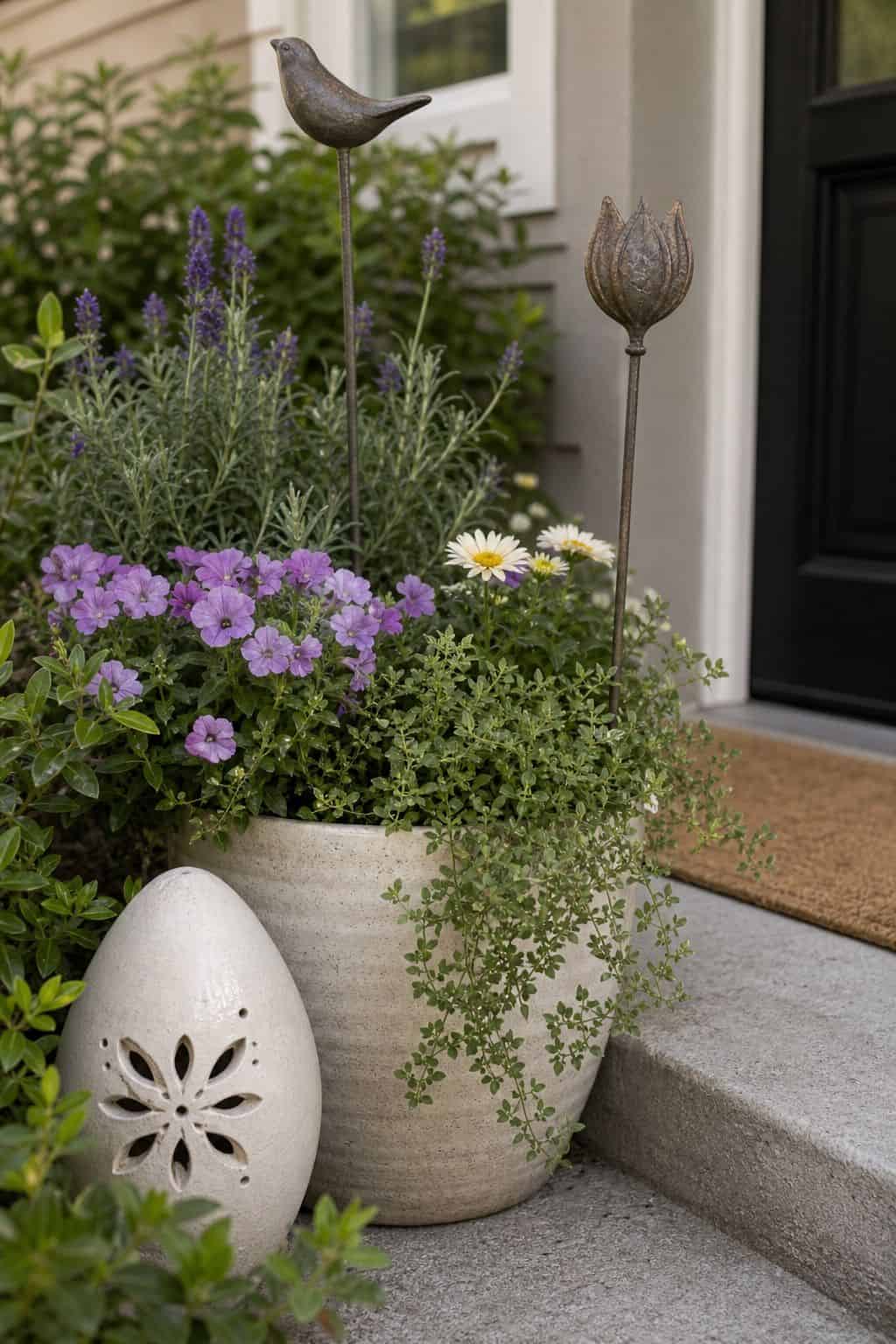


One or two well-placed garden statues or decorative stakes add personality. A small stone Buddha, a vintage iron rooster, a hand-carved wood sign, or a copper rain gauge, all give the porch one or two intentional collected pieces.
Avoid overdoing this, three or fewer statement pieces feel considered; six or more starts to look like a yard sale. Place statues at the foot of a planter, beside the door, or among the climbing vine on a column rather than scattered randomly.
Tucking a statue partly behind a plant, so it peeks out rather than standing fully exposed, makes it feel discovered instead of staged. Choose pieces in weather-tough materials like cast stone, iron, or sealed wood, since cheap resin fades and cracks within a season or two outdoors. One genuinely characterful find, a flea-market lantern or an old garden tool, beats a cluster of generic ornaments.
Read more: Top 15 Small Balcony Garden Ideas to Maximize Your Outdoor Space
13. Create a small rock garden with succulents
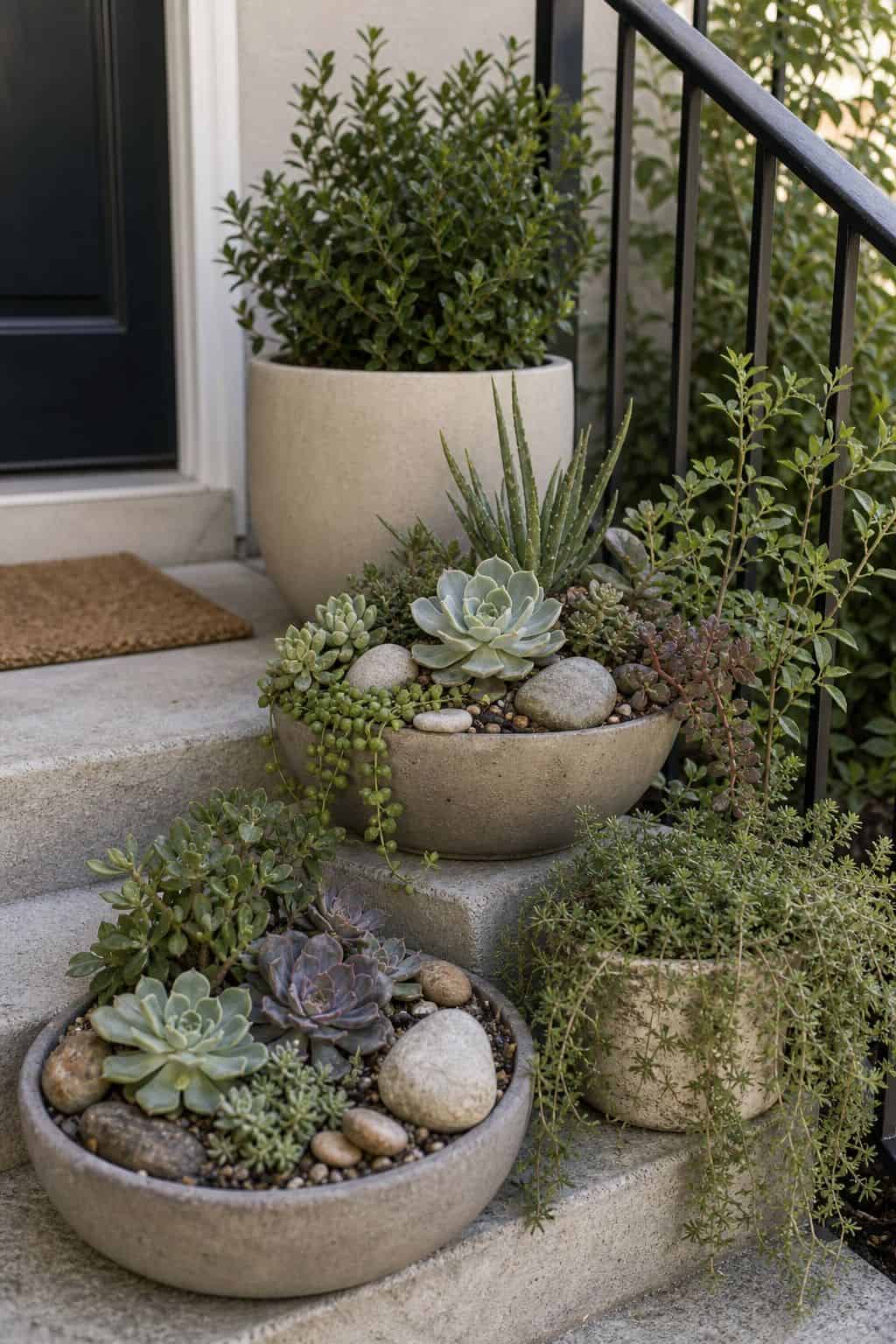


If a section of the porch gets full sun and you want a no-water alternative to traditional planters, a small rock garden with succulents thrives in 4-8 hours of sun and survives drought. Layer river stones or white pea gravel as a base, then plant hen-and-chicks, sedum, agave, or echeveria in clusters.
Pair with one tall agave or yucca as a vertical focal point. Rocks heat up in summer sun, so check that succulents you choose are heat-tolerant; cool-climate species can scorch in zone 8+ summers.
Drainage decides everything here, so a gritty cactus mix and a base that lets water escape keep the succulents from rotting after a heavy rain. A rock garden is the lowest-water option on the whole porch, which makes it the easy answer for a sunny spot you would rather not fuss over. Varying the size and shape of the stones, a few large ones among smaller gravel, gives the little garden a more natural, intentional look.
14. Use colorful garden flags or banners for charm
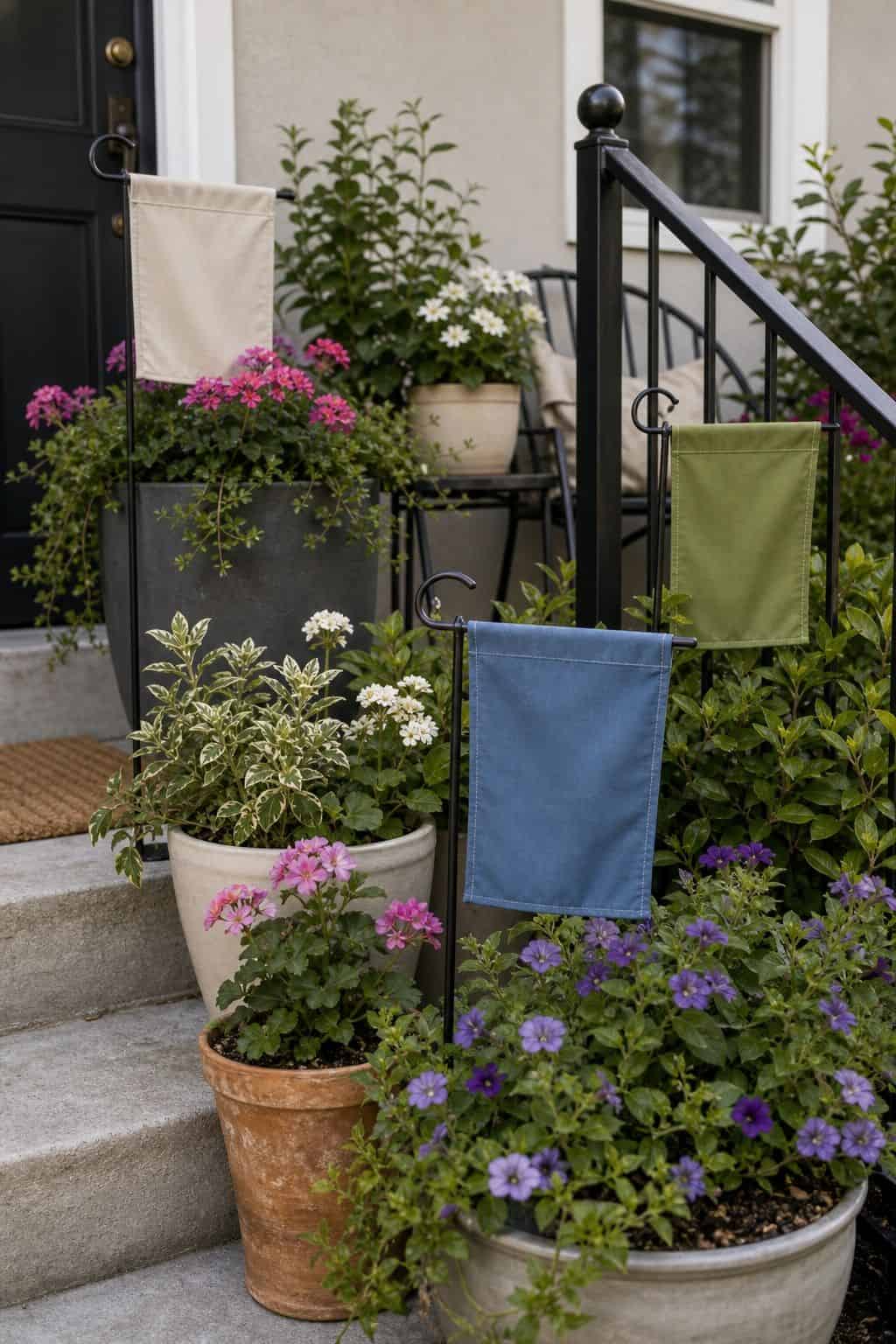


A small seasonal garden flag (12×18 inches) on a stake at the entry or hung from a porch hook adds personality and changes with the seasons. Spring florals, summer beach scenes, fall pumpkins, winter snowflakes, the flag rotation marks the calendar.
Choose flags in fade-resistant outdoor fabric and reinforced stitching. Avoid mass-printed cheap polyester versions that warp and fade within one season; spend $15-25 on a quality flag that survives 2-3 years of outdoor use.
A flag is the cheapest possible way to mark a holiday or change the porch’s mood, since swapping it takes seconds and a few cost less than one planter. Pick a stand or stake with an anti-wind clip so the flag does not wrap and tangle on a gusty day. Keeping a small set, one per season, in a labeled bin makes the rotation a quick, no-thought habit.
Read more: Top 17 Winter Porch Decor Ideas for January and February
15. Incorporate a bench surrounded by flowering plants for seating
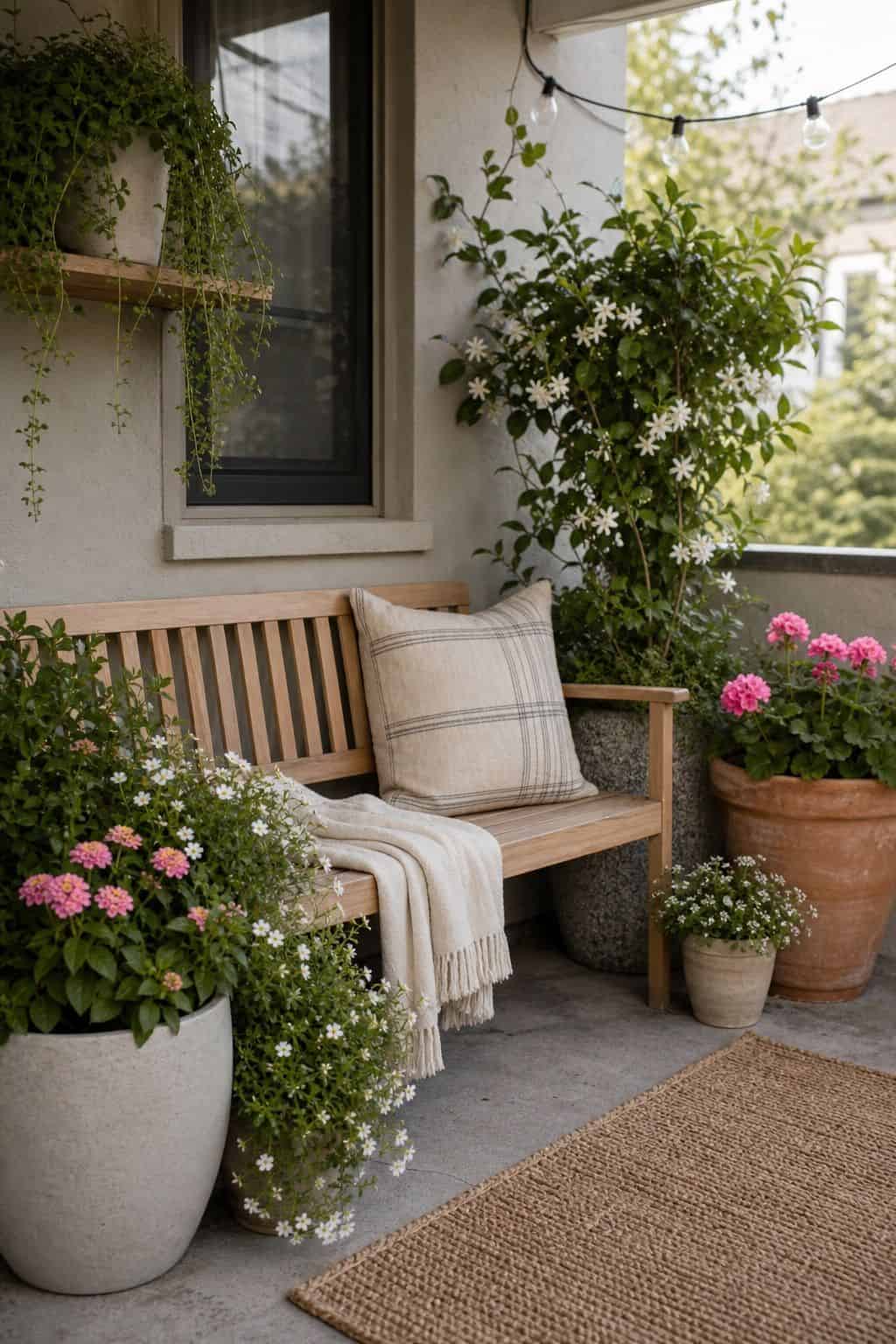


A small bench on a covered porch, surrounded by flowering planters on both sides and a hanging basket above, creates an intentional sit-down moment. Cedar, polywood, or wrought-iron bench 36-48 inches wide seats two comfortably.
Position to face the yard or street if the view is good, or face the door for entry-side conversation. The bench becomes the spot for morning coffee, evening reading, or just a moment between leaving and arriving.
An outdoor cushion or two turns the bench from something people walk past into somewhere they actually sit, and the cushions lift off when rain is coming. Surrounding it with fragrant planters, lavender or a flowering jasmine, means the scent rises every time someone settles in. Even a small bench signals that the porch is meant to be used, not just looked at, which quietly invites a neighbor to stop and visit.
Read more: Top 17 Easter Front Porch Decor Ideas for a Welcoming Entrance
Want every visitor to feel welcomed from the moment they see the porch from the curb?
The Aesthetic Apartment Makeover Guide walks through every room with budget-friendly ideas. $17 now, soon $27.
Frequently Asked Questions
What plants survive on a shaded front porch?
Ferns (Boston, ostrich, Japanese painted), hostas (small varieties), impatiens, begonias, coleus, and caladiums all handle 2-4 hours of sun or less. English ivy and Boston ivy climb columns in shade. Most herbs and flowering annuals need 6+ hours of sun and will languish on shaded porches.
How many plants do I need on the front porch?
A matched pair of large entry planters plus 3-5 additional smaller pots, 2 hanging baskets, and 1-2 climbing vines on columns is the universal sweet spot. Total of 8-12 plants delivers an abundant front porch look without crossing into cluttered.
When should I switch out seasonal porch plants?
Spring (March-April) for tulips, daffodils, pansies. Summer (May-September) for geraniums, petunias, lantana. Fall (October-November) for mums, ornamental kale. Winter (December-February) for evergreen sprigs, holly, or holiday-specific arrangements. Switch evergreen structure plants only every 2-4 years.
What planter size is best for a front porch?
Large entry planters should be 16-24 inches in diameter and 18-30 inches tall to make a real visual impact. Anything smaller looks like an afterthought next to the door. Window boxes can be standard 24-36 inches long. Hanging baskets 10-14 inches diameter for full visual cascade.
Are climbing vines bad for porch columns?
Aggressive vines like English ivy can damage paint and grow into wood siding over time. Wisteria has heavy mature weight that strains weaker structures. Climbing roses, clematis, and jasmine are generally safe on wood, stone, or metal columns. Use a separate trellis to keep the vine slightly off the column structure.
Key Takeaways
- Matched pair of entry planters flanking the front door is the highest-impact porch garden move.
- Mix evergreens with seasonal blooms for year-round style with seasonal rotation.
- Climbing vines on columns (clematis, climbing rose, ivy) add vertical green.
- Hanging baskets and window boxes extend the garden upward and free porch floor space.
- Solar path lights and one porch lantern deliver evening welcome without electrical work.
- Three statement pieces max (statue, birdbath, garden flag) keeps the porch styled instead of cluttered.
Final Thoughts
A front porch garden is the curb-appeal layer that does more for first impressions than the paint color, the doormat, or the door hardware. Start with a matched pair of large entry planters, add evergreen structure, layer in seasonal flowers, hang baskets and a window box, train one climbing vine, and finish with solar path lights. The entry becomes the welcome it should always have been.
Last update on 2026-09-15 / Affiliate links / Images from Amazon Product Advertising API
